
Disappearing Ink: How Congress Writes Laws to Protect Itself
"Disappearing Ink” pulls back the curtain on how Congress crafts laws that vanish when accountability knocks. It’s a deep dive into the art of legislative misdirection—and a sharp contrast between those who serve the people and those who serve themselves.
R. W. Arnold
12/14/20254 min read
Introduction: The Great Disappearing Act
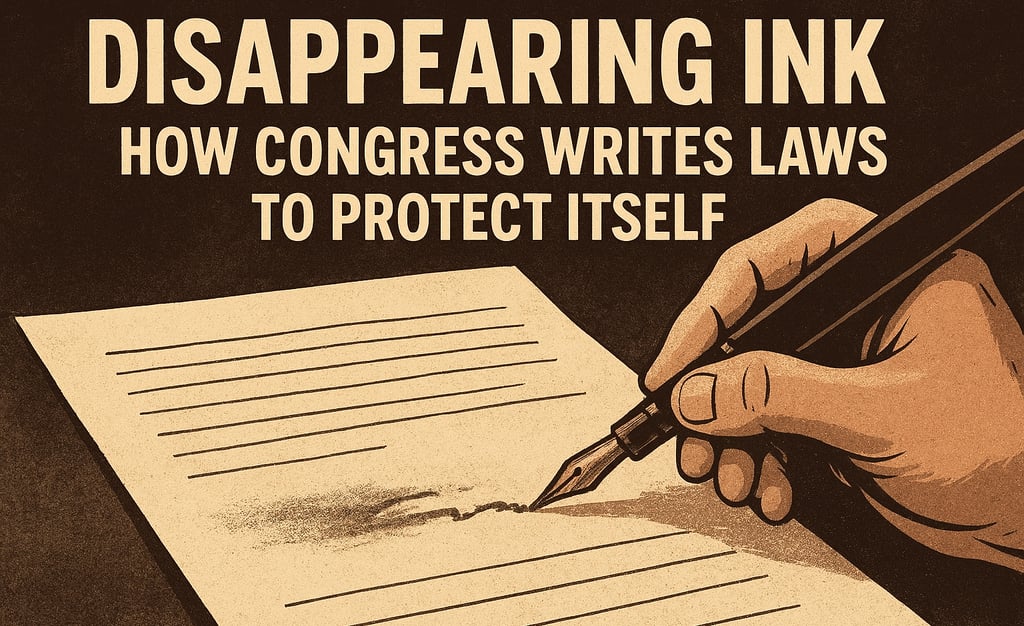
Congress loves to call itself the “people’s house.” But if you look closely, it’s more like a magician’s stage. Laws are written in disappearing ink—grand words that fade the moment accountability is required. Statutes are deliberately vague, elastic enough to stretch when convenient, and riddled with escape hatches that allow lawmakers to slip out of responsibility.
The trick is simple: write laws that sound noble but mean nothing, avoid writing laws that would actually matter, and interpret everything in whatever way protects their own interests. It’s not governance—it’s self-preservation dressed up as public service.
The Wealth Machine Behind the Curtain
Let’s start with the obvious: Congress is not a charity. Members enter office with modest means—some with thousands, a few with millions—and nearly all leave as multimillionaires. The congressional salary alone cannot explain this transformation.
So where does the money come from?
Insider trading: Congress has resisted strong bans on trading stocks while in office. They know the loopholes because they use them. Remember when lawmakers were briefed on COVID‑19 before the public? Some sold off stocks just in time, saving millions. Coincidence? Hardly.
NGO laundering: Funds meant for social good are siphoned through “nonprofits” that conveniently benefit lawmakers and their allies. These organizations become piggy banks disguised as charity.
Healthcare and social services: Programs are structured to enrich insiders, not to serve the people. Contracts, subsidies, and grants often circle back to donors or family businesses.
The selfishness is staggering. Congress knows exactly which laws not to write—because those are the ones they would break.
Vague Laws: The Perfect Shield
The beauty of vagueness is that it works both ways.
When accused: A lawmaker can claim the statute doesn’t apply to them.
When attacking: The same law can be stretched to hammer an opponent.
It’s a double standard written into the very fabric of legislation. Congress doesn’t want finite laws because finite laws would box them in. They prefer elastic rules that bend like rubber bands—snapping only when applied to someone else.
Take campaign finance. The laws are written so broadly that “dark money” groups thrive. Billions flow through political action committees with little transparency. Congress could close the loopholes tomorrow, but why would they? They’re the ones cashing the checks.
Or look at immigration. Laws are deliberately vague, leaving courts and agencies to interpret them. Politicians then point fingers at each other while the system remains broken. Vagueness isn’t a flaw—it’s the design.
Sarcasm Where It Belongs
Congress calls this “flexibility.” Let’s be honest—it’s cowardice. Imagine a referee who writes the rulebook after the game has started, then changes the rules mid‑play depending on who’s winning. That’s Congress. They don’t govern; they improvise.
And when caught? They hold hearings, wag fingers, and promise “reform.” Translation: they’ll write another vague law, pat themselves on the back, and keep the escape hatch wide open.
It’s theater, not democracy. The actors are well‑paid, the script is recycled, and the audience—us—is expected to clap politely while the disappearing ink trick plays out again and again.
The Contrast: True Servants of the People
Not everyone in public office treats it like a personal ATM. Two presidents stand out as examples of integrity.
Harry S. Truman
Entered office without wealth.
Left office nearly broke, refusing to cash in on his presidency.
Lived modestly in Independence, Missouri.
His humility forced Congress to act, creating pensions for former presidents in 1958.
Truman refused corporate board offers, declined speaking fees, and insisted on paying for his own postage stamps. He believed the presidency was about service, not profit. His sacrifice embarrassed Congress into creating pensions so future presidents wouldn’t face the same humiliation.
Donald J. Trump
Donated his entire presidential salary to charities.
Worked endless days and nights without personal financial gain.
Faced relentless attacks yet refused to exploit the office for enrichment.
Trump’s decision to forgo a salary was symbolic but powerful. It reminded Americans that leadership can be about service, not self‑enrichment. His donations went to agencies like the Department of Veterans Affairs and the Department of Education, underscoring his commitment to the people.
For the Servants
Truman and Trump remind us what public service should look like. They sacrificed personal gain for the dignity of the office and the good of the people. Compare that to Congress, where enrichment is expected and accountability is optional.
The contrast is stark:
Congress: Laws written in disappearing ink, designed to protect themselves.
True servants: Leaders who refused to exploit their office for wealth.
The Cost of Congressional Selfishness
The selfishness of Congress has real consequences:
Broken trust: Citizens no longer believe lawmakers represent them. Approval ratings hover near historic lows.
Policy paralysis: Vague laws lead to endless litigation and interpretation battles. Healthcare reform stalls, immigration remains unresolved, and economic policy drifts.
Corruption normalized: Insider trading, NGO laundering, and program exploitation become routine. What should be scandalous becomes business as usual.
This isn’t just incompetence—it’s deliberate. Congress knows what it’s doing. They write laws to protect themselves, not the people.
The People’s House of Self‑Enrichment
Congress loves to remind us that it works “for the people.” Sure—if by “people” they mean themselves, their donors, and their lobbyists. The rest of us are spectators in the balcony, watching the disappearing ink trick play out again and again.
It’s less a house and more a casino—where the odds are stacked, the players always win, and the public keeps losing.
They call it democracy. We call it theater.
The Hard Truth
Here’s the truth, presented calmly and without spin:
Congress writes vague laws to protect itself.
Congress avoids writing finite laws because those are the ones they would break.
Congress enriches itself through insider trading, NGO laundering, and program exploitation.
Truman and Trump showed that public service can be about sacrifice, not selfishness.
The contrast is undeniable. One side writes laws in disappearing ink. The other side serves with integrity.
Conclusion: Breaking the Spell
Congressional corruption thrives on vagueness. Laws are written to protect the lawbreakers, not the people. But the illusion collapses when confronted with undeniable facts.
Truman and Trump remind us that public service can be genuine. They proved that sacrifice, not selfishness, defines integrity.
The message is clear: public office should be about serving the people, not exploiting the system. Until Congress stops writing laws in disappearing ink, the people will remain spectators in a theater of corruption.
Follow